
Understanding the Difference Between Injectable Peptides and Bioactive Peptides
A friend asked me a question recently that made me smile.
"Are these the same peptides everyone is talking about?"
I knew exactly what she meant.
Over the past year, it seems like the word peptides has exploded. You hear about them in podcasts, see them on social media, and maybe you've had friends tell you they're using peptides and feeling great. But here's the problem…
Depending on who you're talking to, they may be referring to two completely different things.
Some are talking about injectable peptides.
Others are talking about bioactive peptides.
Because they share the same name, it's easy to assume they're basically the same. Before I started learning about bioactive peptides, I probably would have assumed that too.
The reality is they're both rooted in the fascinating science of peptides, but they're developed differently, used differently, and designed for different purposes.
By the end of this article, my hope is that you'll not only understand the difference—you'll understand why both exist and where each one fits into the bigger picture of wellness.
First Things First…What Is a Peptide?
Let's keep this simple.
Every protein in your body is made up of amino acids. When a small number of those amino acids link together, they form a peptide.
That's the scientific definition.
But what does that actually mean?
Think of peptides as tiny messengers.
Your body is constantly communicating with itself. Every second of every day, millions of messages are being sent that tell different systems what to do. Some messages help regulate appetite. Others play a role in muscle repair, metabolism, sleep, immune function, skin health, and countless other processes.
Those messages are often carried by peptides.
In fact, your body naturally produces thousands of different peptides. Each one has a specific job, and together they help keep your body functioning the way it was beautifully designed to function.
That's one of the reasons I find peptides so fascinating. This isn't some brand-new scientific discovery or wellness trend. Peptides have been part of human biology all along. What has changed is our understanding of how they work and how researchers can utilize them in different ways.
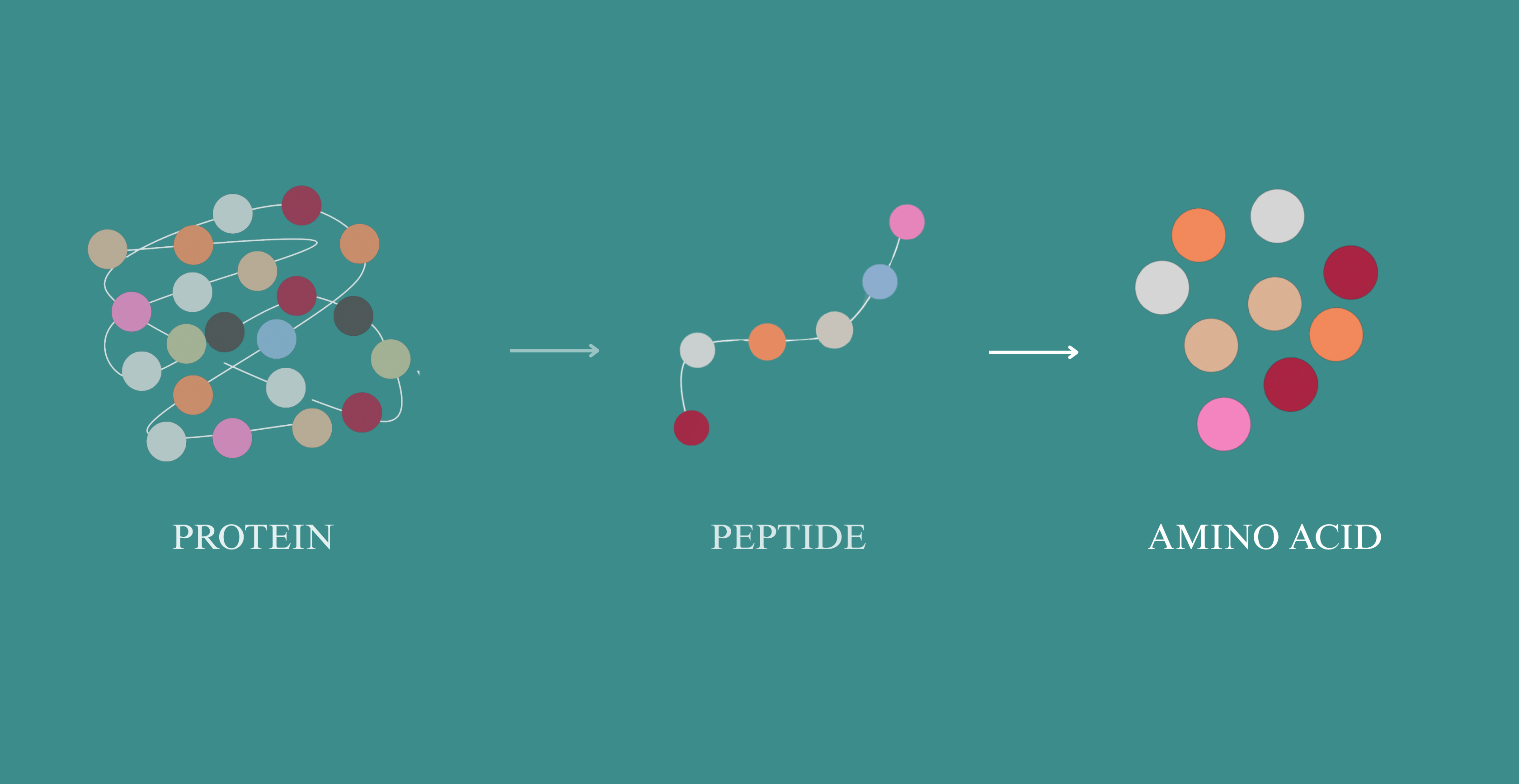
Why Is Everyone Talking About Peptides Now?
If peptides have always existed, why does it suddenly feel like everyone is talking about them?
The short answer is that science has advanced.
Researchers continue to discover more about the incredible role peptides play throughout the body. At the same time, new technologies have made it possible to develop different peptide-based products designed for different purposes.
That's where much of the confusion begins.
When someone says they're using peptides, they could be talking about an injectable peptide that's been synthesized to mimic a naturally occurring peptide in the body.
Or they could be talking about bioactive peptides that are naturally sourced and formulated into an oral wellness product.
Both are peptides.
Both are based on naturally occurring peptide science.
But they aren't interchangeable.
Understanding that distinction is one of the most important parts of this conversation.
The Biggest Misunderstanding
One of the biggest misconceptions I see is that people assume injectable peptides and bioactive peptides are competing options—as if you have to decide which "team" you're on.
I don't see it that way at all.
In fact, I think that's one of the biggest mistakes we make in wellness.
Too often we're encouraged to think in extremes.
Natural or medical.
Nutrition or science.
Lifestyle or medication.
I've found that real wellness usually lives somewhere in the middle.
It's less about choosing sides and more about understanding the purpose of each tool available to us.
That's the perspective I hope you'll have as you read the rest of this article.
Instead of asking,"Which one is better?" I'd encourage you to ask a different question:
"What was each one designed to do?"
Because once you understand that, the rest begins to make a lot more sense.
Two Different Approaches Built on the Same Science
One of the biggest "aha!" moments for me was realizing that scientists didn't invent peptides.
They've been part of your body since the day you were born.
Researchers simply discovered how important they are and began exploring different ways to work with them. That research eventually led to two distinct approaches:injectable peptides and bioactive peptides.
Although both are rooted in the same science, they're developed differently and designed with different purposes in mind.
Injectable Peptides
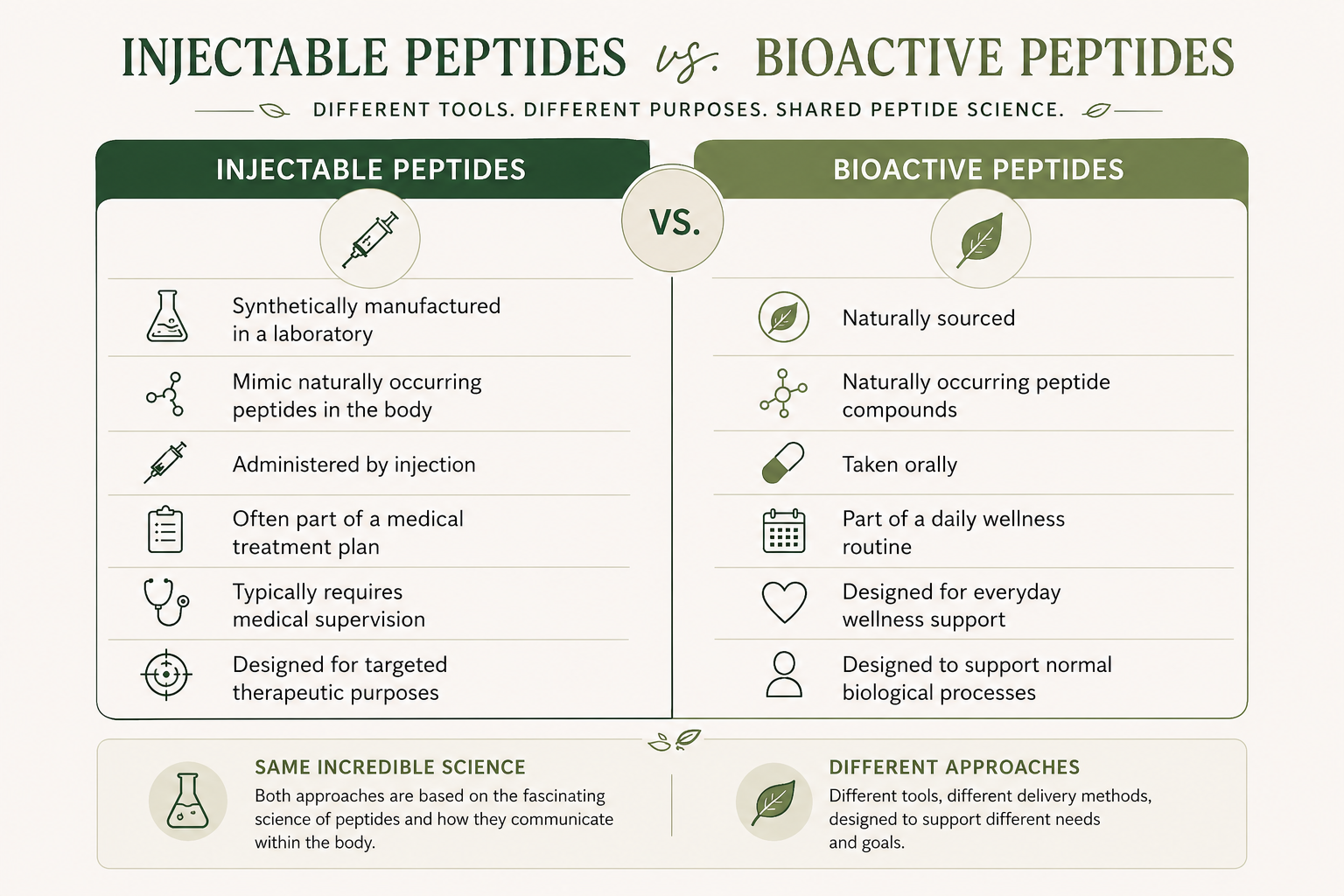
Injectable peptides are synthetically manufactured in a laboratory to mimic specific peptides your body naturally produces. They are designed to interact with particular biological pathways and are often used under the direction of a healthcare provider for specific medical purposes.
Because they're designed for specific therapeutic purposes, they often involve medical supervision and may require ongoing monitoring depending on the peptide and the individual's health goals.
Bioactive Peptides
Bioactive peptides take a different approach.
Instead of being synthetically manufactured in a laboratory, bioactive peptides are naturally sourced and then scientifically optimized to support the body's normal biological processes.
One of the things I appreciate about MAKE Wellness is their philosophy:Powered by science, inspired by nature.
That simple phrase captures what drew me to bioactive peptides in the first place. This isn't about choosing nature over science or science over nature. It's about bringing the two together.
Scientists continue to discover naturally occurring peptide compounds with remarkable biological activity. As they better understand how those peptides communicate within the body, they're able to develop precision formulations designed to support areas like energy, muscle recovery, focus, metabolism, and healthy aging.
Rather than asking your body to do something unnatural, bioactive peptides are designed to support the communication systems your body already uses every day.
That's a fascinating difference—and one that's often overlooked.
So...Do You Have to Choose?
Not necessarily.
This is probably the biggest takeaway I hope you leave with.
Wellness isn't about picking sides.
It's not "medical versus natural."
It's not "science versus nutrition."
And it certainly isn't "injectable peptides versus bioactive peptides."
Different tools can have different purposes.
For example, someone may work with their healthcare provider and determine that a GLP-1 medication or another injectable therapy is the right choice for their current health goals.
At the very same time, they're still going to benefit from eating enough protein, staying hydrated, preserving lean muscle, prioritizing sleep, and building healthy habits that support long-term wellness.
Those things don't stop being important.
In fact, they often become even more important.
That's one of the reasons I often encourage people to think beyond a single product or treatment. Lasting wellness is rarely built on one decision. It's built on hundreds of small decisions that work together over time.
So, What's the Takeaway?
If you remember one thing from this article, let it be this:
Injectable peptides and bioactive peptides are both built on the incredible science of peptides, but they're not the same thing.
Injectable peptides are synthetically manufactured in a laboratory to mimic naturally occurring peptides found in the body. Bioactive peptides are naturally sourced and scientifically optimized into precision formulations designed to support your body's normal biological processes.
Neither approach is trying to replace the other. They simply serve different purposes and may fit into someone's wellness journey in different ways.
Learning that distinction completely changed the way I thought about peptides, and I hope it helped clear up some of the confusion for you too.
If this article sparked new questions, you're not alone. In the coming weeks, I'll be diving deeper into topics like how bioactive peptides work, why they're getting so much attention, and what the research says about supporting healthy aging.
My goal is to make wellness easier to understand.There's so much information online, and it can be overwhelming trying to sort through it all. If I can help simplify the science so you feel more confident making decisions about your health, then I've done my job.
Because when you understand the "why," you're much more likely to stick with the habits that help you feel your best.